
Bunk Beds with Trundles: A Complete Buying Guide
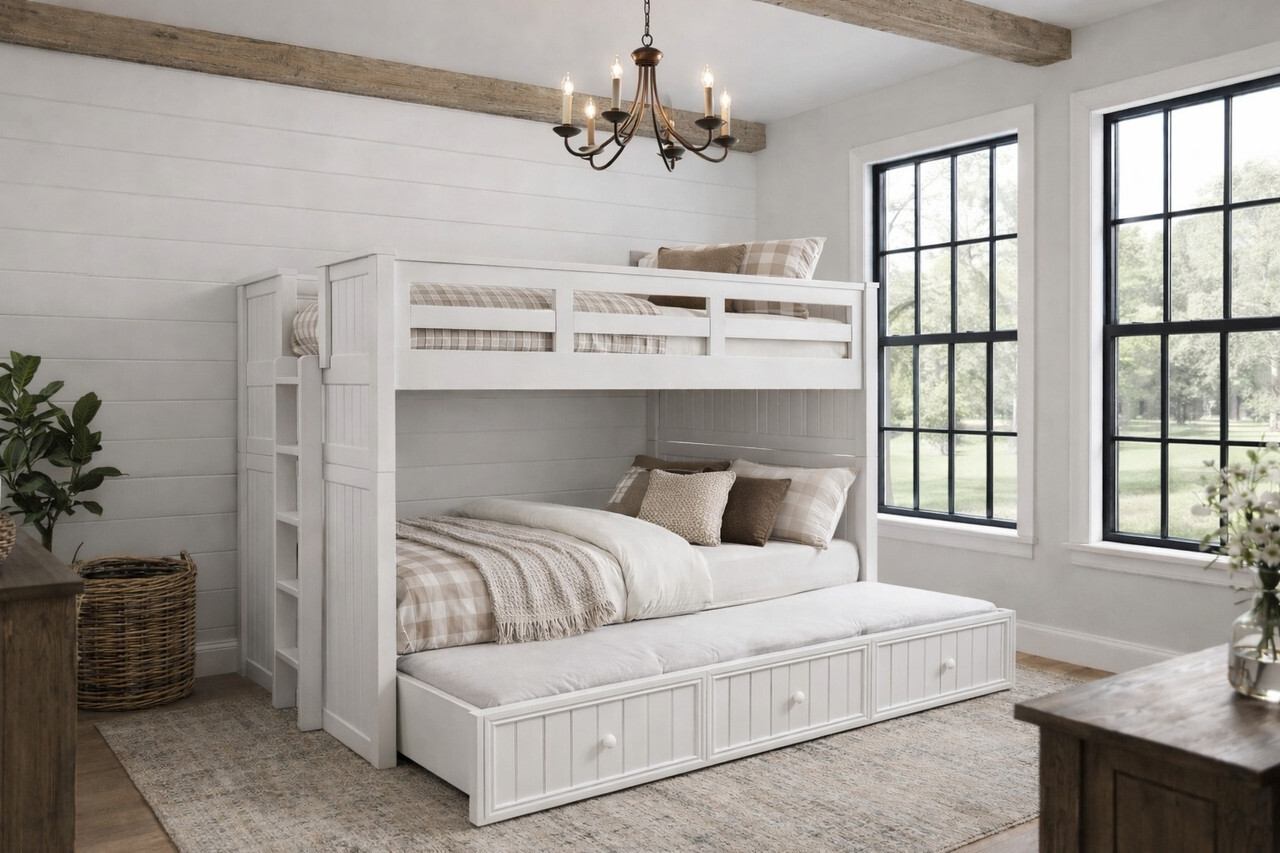
Bunk beds with trundles combine space-saving sleep arrangements with the flexibility of an additional bed that can be stored underneath when it is not in use. They can be especially useful in children's rooms, guest rooms, vacation homes, and other spaces where an extra sleeping surface is helpful without permanently taking up additional floor space.
Choosing the right bunk bed with a trundle, however, involves more than simply selecting the correct bed size. The size of the trundle, mattress thickness, available floor space, and even the bunk bed's ladder configuration can affect how well the trundle works in the room.
For example, some angled ladders extend into the area needed to pull out a trundle, while a properly positioned straight or vertical ladder can leave that space unobstructed. You also need enough open floor space beside the bunk bed to fully extend the trundle and comfortably access it.
In this guide, we'll explain how bunk bed trundles work, the different sizes available, mattress and clearance requirements, ladder considerations, and how to determine whether a trundle is the right choice for your room.
What Is a Trundle Bed?
A trundle bed is a low-profile bed that stores underneath another bed and rolls out when an additional sleeping surface is needed. When not in use, the trundle slides back underneath the bed, allowing the same floor space to serve more than one purpose.
On a bunk bed, the trundle is positioned beneath the lower bunk. This effectively allows a traditional two-bed bunk bed to provide a third sleeping surface without increasing the overall footprint of the bunk bed while the trundle is stored.
Trundles are typically equipped with casters or wheels so they can be pulled out from underneath the bed. Unlike a pop-up trundle, which may raise to approximately the height of the main bed, bunk bed trundles generally remain close to floor level.
Some trundles can also serve a second purpose. When a mattress is removed, models with removable dividers can provide a large under-bed storage area for bedding, clothing, toys, or other items.
One important consideration is that the available space underneath a bunk bed is limited. For that reason, trundle mattress size and thickness must be matched to the specific bunk bed and trundle rather than assuming that any standard mattress will fit.
Trundle Bed Sizes and Compatibility
Bunk bed trundles are available in several sizes, including Twin, Twin XL, Full, and Full XL. The appropriate trundle size depends on the dimensions and design of the bunk bed, particularly whether the lower bed is a standard-length or extra-long configuration.
For bunk beds with a standard Twin or Full lower bed, the available trundle options may include:
Twin Trundle – Uses a standard Twin-size mattress and provides an additional sleeping surface while requiring less pull-out space.
Full Trundle – Uses a standard Full-size mattress and provides a wider sleeping surface when the bunk bed is designed to accommodate it.
For extra-long bunk beds with a Full XL or Queen lower bed, the corresponding trundle options are:
Twin XL Trundle – Provides the additional length of a Twin XL mattress while requiring less width when extended.
Full XL Trundle – Provides a wider extra-long sleeping surface for bunk beds designed to accommodate the larger trundle.
The trundle does not necessarily have to be the same width as the mattress on the lower bunk. For example, a Full lower bunk may accommodate either a Twin or Full trundle, while a Queen lower bunk may accommodate either a Twin XL or Full XL trundle.
What does need to match is the length and design of the bunk bed. A standard-length trundle should not be substituted for an XL trundle simply because it physically appears that it might fit.
This is especially important when purchasing a trundle separately or adding one to an existing bunk bed. Trundles are not universally interchangeable. Frame dimensions, rail height, the space between the bed posts, and the overall design of the bunk bed can all affect whether a particular trundle will fit and operate properly.
For that reason, it is best to use a trundle specifically designed or approved for the bunk bed model you are purchasing.
Mattress Requirements for Bunk Bed Trundles
Choosing the correct mattress for a trundle is important because the mattress must fit both the trundle frame and the available space underneath the bunk bed. A mattress that is too thick can prevent the trundle from sliding completely underneath the lower bed.
For the bunk beds and trundles offered by JustBunkBeds, we generally recommend a mattress no more than 8 inches thick for the trundle. This provides a comfortable sleeping surface while maintaining the clearance needed to roll the trundle in and out.
The mattress size must also match the trundle:
Twin trundle: Twin mattress
Twin XL trundle: Twin XL mattress
Full trundle: Full mattress
Full XL trundle: Full XL mattress
Mattress thickness is different from mattress size. Two mattresses may both be labeled Twin, for example, while one is 8 inches thick and another is 12 inches thick. Both have approximately the same length and width, but the thicker mattress may not fit beneath the bunk bed when placed on the trundle.
When purchasing a mattress for a trundle from another manufacturer, always check the bunk bed manufacturer's maximum recommended mattress thickness and the available under-bed clearance before ordering.
Does a Trundle Mattress Need to Be Thinner?
In most cases, yes. Trundle mattresses are typically thinner than conventional mattresses because the entire mattress and trundle frame must fit underneath the lower bunk.
A thinner mattress does not necessarily mean an uncomfortable mattress. Many modern mattresses are designed specifically for lower-profile applications and can provide good support without requiring the height of a traditional mattress.
The key is to stay within the maximum mattress thickness specified for the trundle and bunk bed.
How Much Floor Space Does a Trundle Need?
One of the advantages of a bunk bed with a trundle is that the additional bed takes up very little extra floor space when it is stored. However, you need enough open space beside the bunk bed to fully pull out the trundle when it is being used.
The amount of space required depends primarily on the width of the trundle.
As a general room-planning guide:
Twin or Twin XL trundle: Allow approximately 43 inches of open floor space beside the bunk bed.
Full or Full XL trundle: Allow approximately 56 inches of open floor space beside the bunk bed.
The length of the trundle also matters when planning around walls, doors, dressers, and other furniture. A standard Twin or Full trundle is approximately 75 inches long, while Twin XL and Full XL trundles are approximately 80 inches long.
These measurements are especially useful when deciding where to position the bunk bed. A room may have enough space for the bunk bed itself but not enough unobstructed floor area to comfortably extend the trundle.
Measure the Trundle's Pull-Out Area
Before choosing a bunk bed with a trundle, measure outward from the side of the bunk bed where the trundle will be accessed. Make sure this area is not blocked by a wall, dresser, nightstand, desk, or other furniture.
Also consider how the room will function once the trundle is extended. Ideally, there should still be a practical path for entering and leaving the room and for accessing the bunk bed.
Remember that the trundle only needs this additional floor space while it is being used. During the day, it can be rolled back underneath the lower bunk, returning that floor area to normal use.
This ability to temporarily add another sleeping surface is one of the reasons bunk beds with trundles work particularly well in guest rooms, children's rooms, and vacation homes where an extra bed is useful but may not be needed every night.
Ladder Placement and Trundle Access
The ladder configuration is an important consideration when choosing a bunk bed with a trundle. A ladder that extends into the space in front of the lower bunk can interfere with pulling the trundle in and out.
An angled or slanted ladder can extend approximately 20 to 22 inches outward from the bunk bed and into the trundle's pull-out path. As a result, a slanted ladder will interfere with trundle access.
When a trundle will be used, choose a compatible straight or vertical ladder configuration that keeps the trundle's pull-out area unobstructed.
Straight and Vertical Ladders Can Preserve Trundle Access
A straight or vertical ladder generally requires much less floor space than an angled ladder. On bunk beds designed with the ladder positioned away from the trundle's pull-out path, the trundle can roll out without the ladder interfering with access.
Some bunk beds place the ladder on the end of the bed, leaving the entire front of the lower bunk open. Other designs use a short vertical ladder on the front that does not extend down into the trundle area.
These configurations can be especially useful when a trundle will be used frequently.
When comparing bunk beds with trundles, don't look only at the dimensions of the bed and trundle. Look at the entire configuration, including where the ladder is located and how far it extends into the room.
A few inches of ladder placement can make a significant difference in how easily the trundle can be used.
Trundle Bed vs. Under-Bed Storage
The space underneath the lower bunk can often be used for either a trundle bed or dedicated storage. Deciding between the two depends on whether an additional sleeping surface or everyday storage is more important for the room.
A trundle bed is usually the better choice when you regularly need an additional place to sleep. It allows the extra bed to remain stored underneath the bunk until needed, without permanently occupying additional floor space.
Under-bed drawers, on the other hand, provide dedicated storage for clothing, bedding, toys, and other items. Because drawers can be opened individually, they may be more convenient for items that are accessed frequently.
Can a Trundle Be Used for Storage?
Some trundles can serve both purposes.
Certain trundle designs include removable dividers that support the mattress when the trundle is being used as a bed. When the mattress and dividers are removed, the trundle becomes a large open storage compartment.
This can provide useful flexibility. The trundle might be used as an additional bed when guests are staying and converted to storage when an extra sleeping surface is not needed.
However, a trundle used for storage functions differently from dedicated under-bed drawers. A trundle typically pulls out as one large unit, while individual drawers allow you to access smaller storage areas without pulling out the entire compartment.
When deciding between a trundle and under-bed drawers, consider how often you expect to use the extra bed, how much storage the room needs, and how frequently you will need to access the items stored underneath.
For rooms that occasionally need an additional sleeping surface, a trundle that can also be converted to storage can offer the best of both uses.
Can Adults Sleep on a Trundle Bed?
Yes, adults can sleep on some trundle beds, provided the trundle is designed to support the sleeper's weight and the mattress provides adequate space and comfort.
The first consideration is trundle size. A standard Twin mattress is approximately 75 inches long, while a Twin XL is approximately 80 inches long. That additional 5 inches can make a noticeable difference for a taller teenager or adult.
A Full trundle provides more width than a Twin, while a Full XL combines the additional width of a Full mattress with the 80-inch length of an XL mattress. For an adult guest, the extra width and length can make a Full XL trundle a particularly comfortable option when the bunk bed is designed to accommodate one.
Check the Trundle's Weight Capacity
Mattress size alone does not determine whether a trundle is appropriate for an adult. The construction and weight capacity of the trundle are equally important.
On many of the trundles offered by JustBunkBeds, the mattress is supported by wooden slats with boards installed over the slats, creating a solid, enclosed surface beneath the mattress. The trundle rolls on eight heavy-duty wheels attached to the slat structure, helping distribute the load and allowing the trundle to roll in and out from underneath the bunk bed.
Even with a well-constructed trundle, do not assume that the weight capacity of the bunk bed automatically applies to the trundle. The upper bunk, lower bunk, and trundle are separate sleeping surfaces and may have different weight limits.
Always check the manufacturer's stated weight capacity for the trundle itself before using it for an adult sleeper.
Mattress comfort should also be considered. Because trundle mattresses are generally lower profile, choosing a supportive mattress within the manufacturer's maximum thickness requirement can make a significant difference, particularly when the trundle will be used by an adult.
Who Are Bunk Beds With Trundles Best For?
Bunk beds with trundles can work well anywhere an additional sleeping surface is useful but a permanent third bed would take up too much room. Because the trundle stores underneath the lower bunk when it is not being used, the room can retain more open floor space during the day.
They can be particularly useful in:
Children's rooms – A trundle provides an additional sleeping surface for siblings, friends, or overnight guests without adding another permanent bed to the room.
Teenagers' rooms – Twin XL and Full XL trundles can provide additional length for taller sleepers while still storing underneath the bunk bed.
Guest rooms – A bunk bed with a trundle can accommodate an additional guest while allowing the room to serve other purposes when the extra bed is not needed.
Vacation homes and rental properties – Trundles can increase sleeping flexibility without requiring another permanent bed or taking up additional floor space when stored.
Shared bedrooms – A trundle can provide a third sleeping surface while keeping the room more open when all three beds are not being used.
A bunk bed with a trundle can be especially practical when the third sleeping surface is needed occasionally rather than every night. The trundle can remain stored most of the time and be pulled out only when needed.
For households that expect to use all three sleeping surfaces every night, room layout becomes more important. Make sure there is sufficient floor space to leave the trundle extended while still maintaining comfortable access around the beds and through the room. The best choice ultimately depends not only on how many people need a place to sleep, but also on how often the trundle will be used and how the room needs to function when it is extended.
What to Check Before Buying a Bunk Bed With a Trundle
Before choosing a bunk bed with a trundle, take a few measurements and confirm that the bed, trundle, mattress, and room will work together.
Here are the most important things to check:
Trundle size and compatibility – Confirm which trundle sizes are designed for the specific bunk bed. Standard-length and XL trundles are not necessarily interchangeable.
Mattress size and thickness – Make sure the mattress matches the trundle size and does not exceed the manufacturer's maximum recommended thickness.
Available pull-out space – Measure the open floor area beside the bunk bed. Allow approximately 43 inches for a Twin or Twin XL trundle and 56 inches for a Full or Full XL trundle.
Trundle length – Remember that standard Twin and Full trundles are approximately 75 inches long, while Twin XL and Full XL trundles are approximately 80 inches long.
Ladder placement – A slanted ladder extends into the trundle's pull-out path and will interfere with trundle access. When using a trundle, choose a compatible straight or vertical ladder configuration that keeps the pull-out area unobstructed.
Room layout – Consider doors, dressers, desks, nightstands, and other furniture that could interfere with extending the trundle.
Weight capacity – If the trundle will be used by an adult or older teenager, verify the manufacturer's stated weight capacity for the trundle itself rather than relying on the bunk bed's weight rating.
Sleeping space vs. storage – Decide whether an additional bed or dedicated under-bed drawers will be more useful. Some trundles with removable dividers can provide both sleeping and storage functionality.
A bunk bed with a trundle works best when all of these elements are considered together. The bunk bed may fit comfortably in the room while the trundle does not, or the trundle may fit beneath the bed but be difficult to access because of the ladder or nearby furniture.
Taking a few measurements before ordering can help ensure that the complete configuration works as intended once the bunk bed is assembled.
Frequently Asked Questions About Bunk Beds With Trundles
Can you add a trundle to any bunk bed?
No. A bunk bed must have sufficient space and clearance underneath the lower bunk, and the trundle must be compatible with the dimensions and design of the bed. Trundles are not universally interchangeable, so it is best to use one specifically designed or approved for the bunk bed model.
What size mattress goes on a bunk bed trundle?
The mattress should match the size of the trundle. A Twin trundle uses a Twin mattress, a Twin XL trundle uses a Twin XL mattress, a Full trundle uses a Full mattress, and a Full XL trundle uses a Full XL mattress.
Mattress thickness is also important. For the trundles offered by JustBunkBeds, we generally recommend a mattress no more than 8 inches thick.
Does the trundle have to be the same size as the lower bunk?
No. The trundle does not necessarily need to be the same width as the lower bunk. For example, a Full lower bunk may accommodate either a Twin or Full trundle, while a Queen lower bunk may accommodate either a Twin XL or Full XL trundle.
The important consideration is using a trundle size that is compatible with the particular bunk bed.
Can you use a trundle with a slanted ladder?
A slanted ladder and trundle are not a good combination because the ladder extends into the trundle's pull-out path and interferes with access. If you plan to use a trundle, choose a compatible straight or vertical ladder configuration that keeps the pull-out area unobstructed.
How much room do you need to pull out a trundle?
As a general planning guideline, allow approximately 43 inches of open floor space beside the bunk bed for a Twin or Twin XL trundle and approximately 56 inches for a Full or Full XL trundle. Also consider nearby furniture, doors, and walking paths so the room remains usable when the trundle is extended.
Can adults sleep on a bunk bed trundle?
Adults can sleep on some trundles, provided the trundle is appropriately sized and rated to support the sleeper. Twin XL and Full XL trundles provide approximately 80 inches of mattress length, which can be useful for taller teenagers and adults. Always verify the manufacturer's stated weight capacity for the trundle itself.
Can a trundle be used for storage?
Some can. Certain trundles have removable mattress-support dividers. When the mattress and dividers are removed, the trundle can function as a large under-bed storage compartment.
This provides the flexibility to use the same under-bed space for an additional sleeping surface when needed and for storage at other times.
Is a trundle better than under-bed drawers?
It depends on how you plan to use the room. A trundle is generally more useful when an additional sleeping surface is needed, while individual drawers provide more convenient everyday access to stored items.
If you only need an extra bed occasionally, a trundle that can also be converted to storage can provide the flexibility of both.