
Bunk Bed Space & Clearance Guide: How Much Room Do You Need?
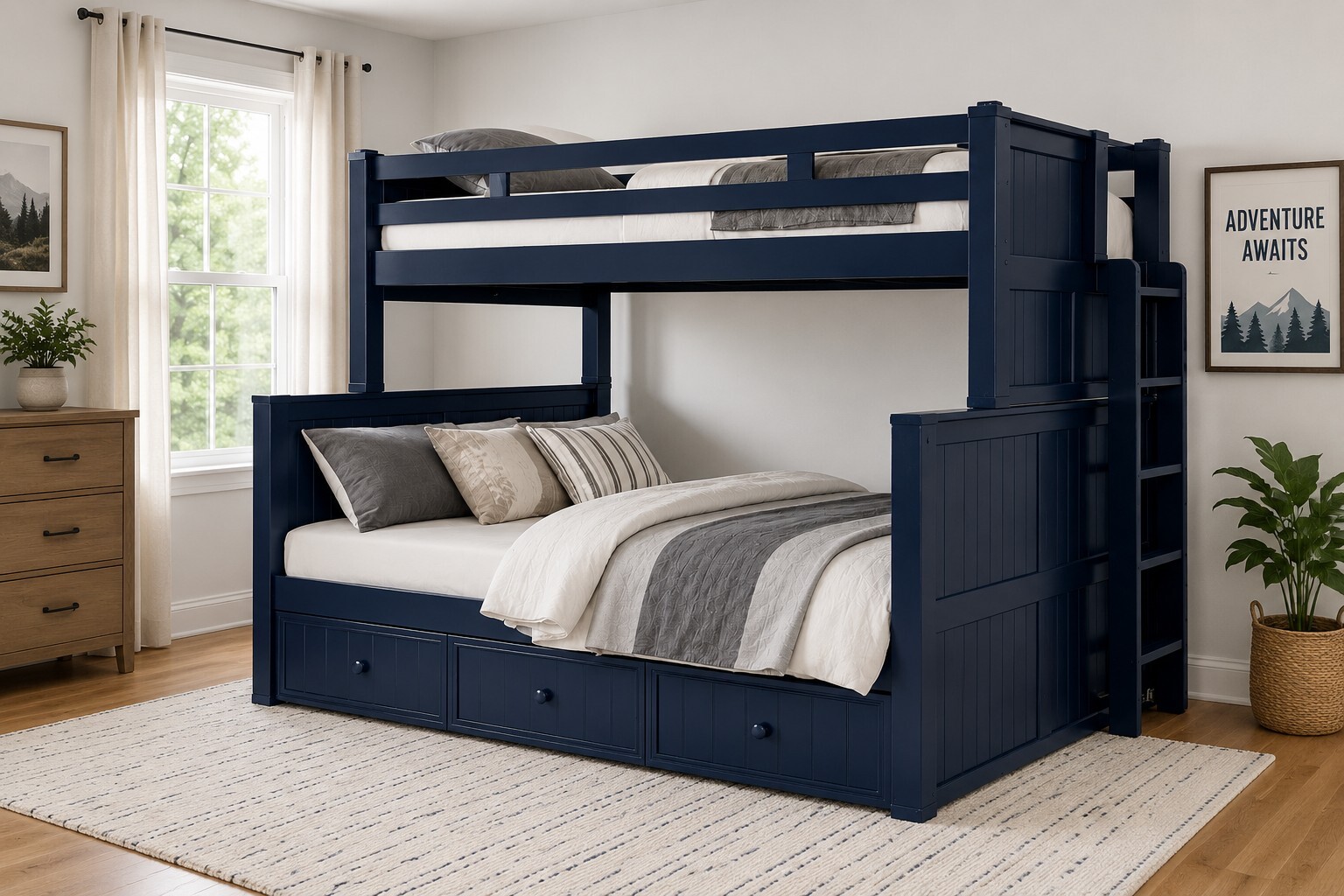
Choosing the right bunk bed involves more than measuring the length and width of the bed itself. A bunk bed may physically fit in your room but still leave too little space to comfortably climb the ladder, pull out a trundle, or move around nearby furniture.
This is especially important when choosing dual-height bunk beds with a ladder at the end or bunk beds equipped with Twin or Full-size trundles.
Before ordering a bunk bed, consider not only its dimensions but also the additional space needed to actually use it.
Bunk Bed Dimensions vs. Usable Room Space
One of the most common room-planning mistakes is comparing the dimensions of the bunk bed directly with the dimensions of the available wall or floor space.
For example, suppose a Twin dual-height bunk bed measures 87 inches long and you have 90 inches of available wall space.
Technically, the bunk bed fits.
But if the ladder is located at the end of the bunk bed, only 3 inches remain between the ladder and the wall or nearby furniture. That does not provide enough room for someone to comfortably approach and climb the ladder.
The better question isn't simply: “Will the bunk bed fit?”
It is:
“Will the bunk bed fit with enough clearance to use it comfortably?”
Room dimensions tell you whether a bunk bed will physically fit, but usable vertical space is equally important. Mattress thickness, ceiling height and the distance between the upper and lower bunks all affect how comfortable the finished setup will be. For a closer look at these measurements, see our complete guide to bunk bed clearance
How Much Space Should You Leave for an End Ladder?
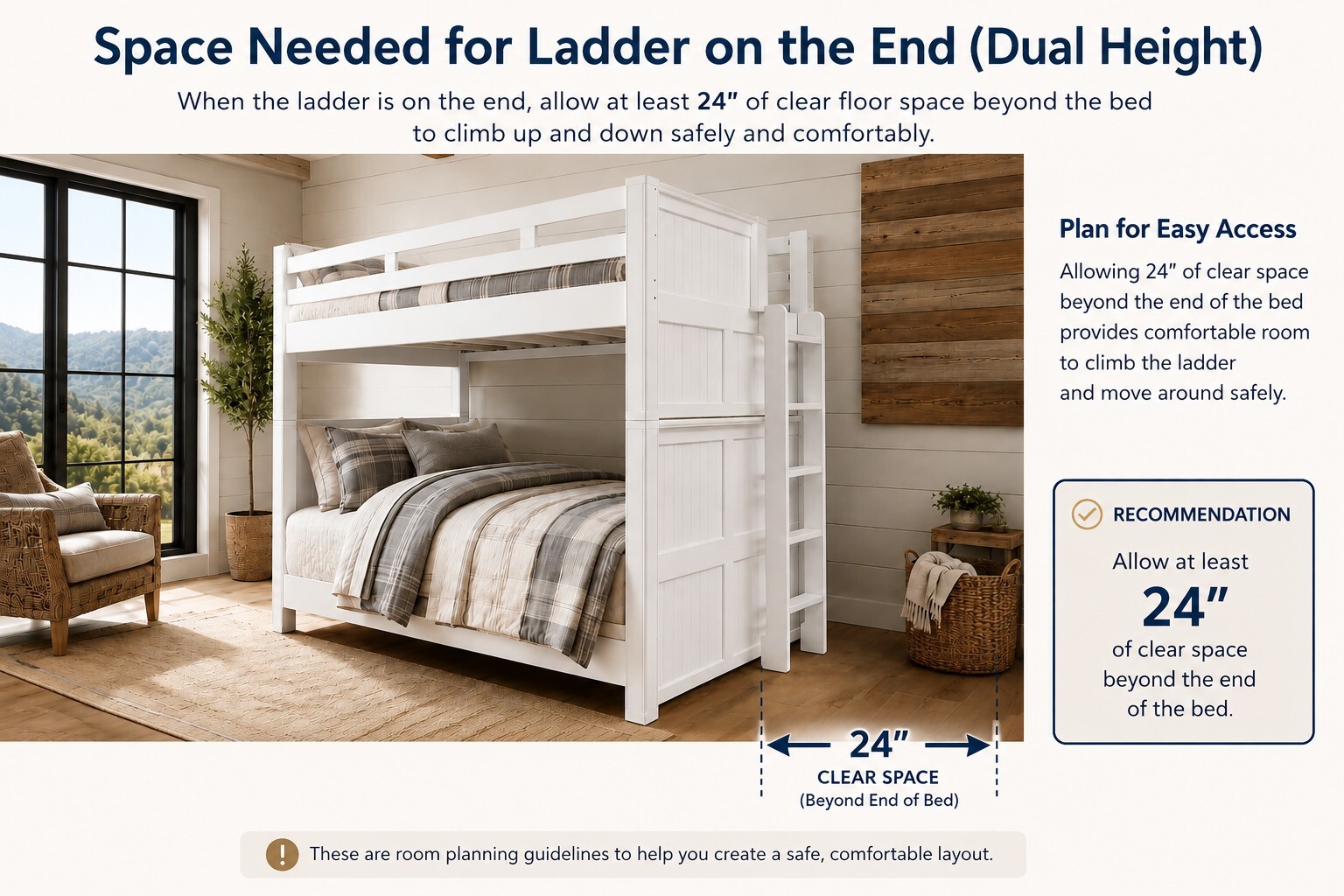
For bunk beds with a ladder located at the end, we recommend allowing approximately 24 inches of open space beyond the ladder whenever possible.
This provides room for the person using the upper bunk to approach the ladder and climb without being squeezed between the bed and a wall, dresser, desk, or other furniture.
Here are practical room-planning dimensions for our dual-height bunk beds:
Bunk Bed Size Bunk Length Suggested Ladder Clearance Practical Room Length
Twin 87" 24" 111"
Twin over Full 87" 24" 111"
Twin XL 91.5" 24" 115.5"
Twin XL over Full XL 91.5" 24" 115.5"
Full 87" 24" 111"
Full XL 91.5" 24" 115.5"
Queen 91.5" 24" 115.5"
These measurements are intended as room-planning guidance, rather than minimum installation requirements.
A Simple Example
Consider a Twin dual-height bunk bed measuring 87"L × 43"W.
If the available space is 90 inches long, the bed itself will fit with approximately 3 inches remaining.
However, that doesn't provide practical access to an end ladder.
Allowing approximately 24 inches for ladder access means planning for roughly: 87" bunk bed + 24" ladder clearance = 111" of usable room length
That's 9 feet 3 inches.
This is why measuring only the bunk bed can sometimes be misleading.
Ladder Location Can Change Your Space Requirements
Not every bunk bed requires the same type of clearance.
A ladder located at the end of the bunk bed requires open space beyond that end so someone can approach and climb it.
A vertical ladder on the long side of a bunk bed uses floor space differently because the person approaches the ladder from the side.
A slanted or angled ladder can be easier to climb, but it extends farther into the room and therefore requires additional floor space.
When comparing bunk beds, don't look only at overall length and width. Consider where the ladder is located and how the person using the upper bunk will get to it.
This can be particularly important in smaller bedrooms, vacation homes, cabins, rental properties, and rooms containing multiple bunk beds.
How Much Room Does a Trundle Bed Need?
A trundle is an excellent way to add another sleeping surface without permanently taking up additional floor space.
When closed, the trundle stores underneath the bunk bed.
When it is time to use it, however, the trundle must be pulled out into the room. This can dramatically change the amount of floor space required.
This is another area where looking only at the bunk bed dimensions can create problems.
A room may easily accommodate the bunk bed when the trundle is closed but not have enough open floor space to fully extend the trundle.
Twin vs. Full Trundle Space
Our Twin and Twin XL trundles are approximately 43 inches wide, while our Full and Full XL trundles are approximately 56 inches wide.
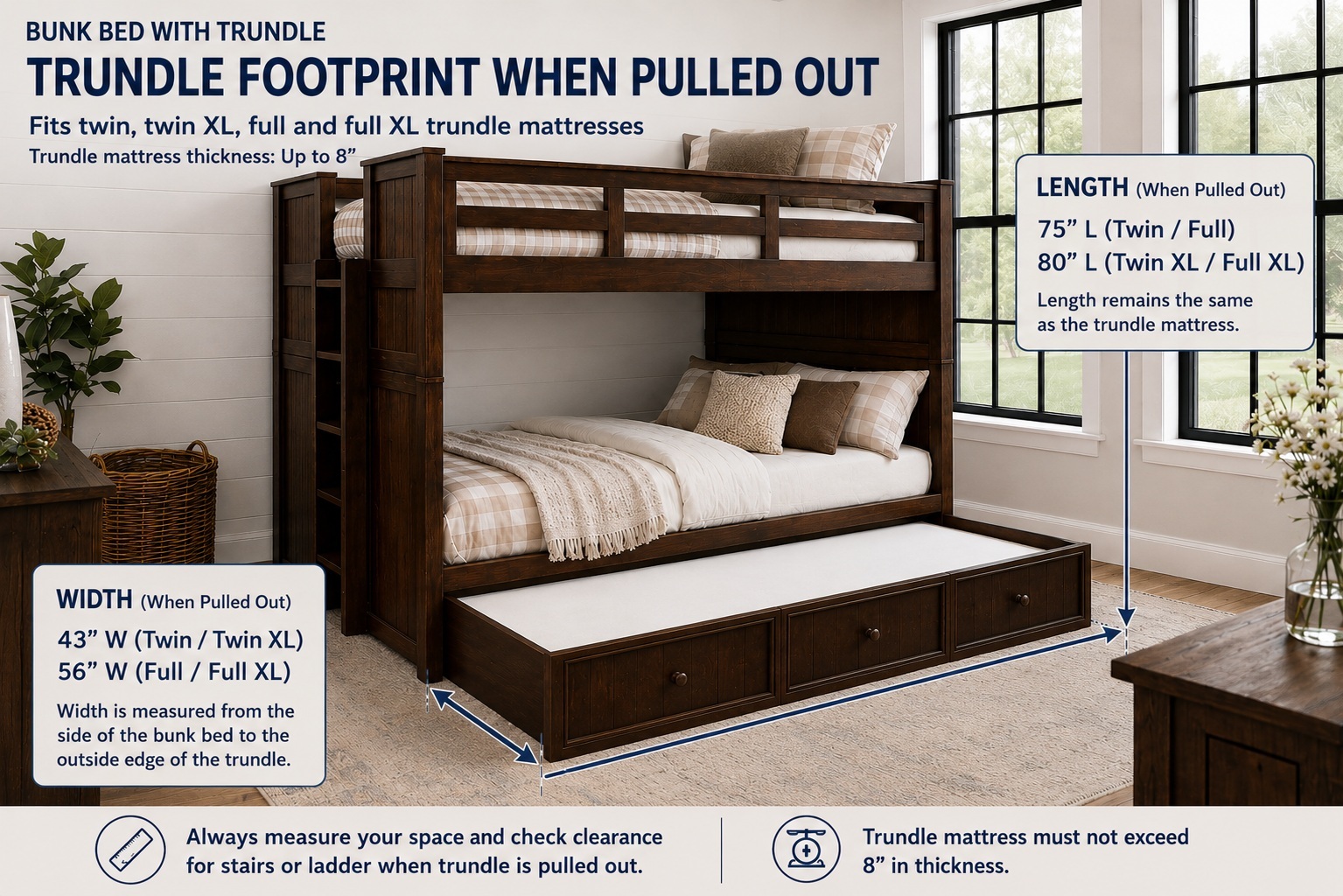
That difference becomes important when planning your room.
The following figures are useful for preliminary room planning:
Bunk Bed Bunk Width Trundle Trundle Width Approx. Room Width to Plan For*
Twin 43" Twin 43" 86"
Full 57.5" Twin 43" 100.5"
Full 57.5" Full 56" 113.5"
Queen 67" Twin XL 43" 110"
Queen 67" Full XL 56" 123"
These figures are intended for preliminary room planning and are based on the approximate combined width of the bunk bed and trundle. Actual space required may vary slightly depending on how far the trundle extends from underneath the bunk bed.
This table shows something that isn't obvious when looking at the bunk bed dimensions alone.
A Queen Bunk Bed With a Full XL Trundle Is a Good Example
Consider a Queen bunk bed that measures approximately 67 inches wide.
With the trundle stored underneath, the bunk bed requires roughly that amount of floor width. A Full XL trundle is approximately 56 inches wide.
For preliminary room planning, combining these dimensions means allowing up to approximately:
67" + 56" = 123"
That's approximately 10 feet 3 inches.
The actual extended footprint may be slightly less depending on how the trundle sits beneath the bunk bed, but the example illustrates an important point:
A bedroom can be large enough for the Queen bunk bed while still being too narrow to comfortably use a Full XL trundle.
A Twin XL trundle requires less floor space:
67" + 43" = approximately 110"
That's a difference of about 13 inches. For some rooms, those 13 inches can determine whether a Twin XL or Full XL trundle is the better choice.
Full Bunk Bed: Twin or Full Trundle?
A Full bunk bed presents another useful example because it may be paired with either a Twin or Full trundle.
The Full bunk bed is approximately 57.5 inches wide.
For preliminary room planning:
Full bunk with Twin trundle:
57.5" + 43" = approximately 100.5"
Full bunk with Full trundle:
57.5" + 56" = approximately 113.5"
That's approximately 13 inches of difference.
If sleeping capacity is the priority and the room has sufficient floor space, a Full trundle may make sense.
If space is tighter, a Twin trundle may provide the additional sleeping surface while requiring less room when extended.
Don't Forget Nearby Furniture
The dimensions of the room aren't the only consideration.
Before choosing your bunk bed location, look at everything surrounding it:
- Dressers and nightstands
- Desks
- Closet doors
- Bedroom doors
- Heating and air-conditioning vents
- Windows
- Other beds or bunk beds
- Furniture that may block ladder access
- Furniture that may prevent a trundle from opening completely
A trundle that cannot be completely pulled out because it hits a dresser or other furniture isn't practical to use.
The same applies to a ladder positioned too close to a wall.
Measure the Room With the Bunk Bed in Use
One of the easiest ways to avoid a space-planning mistake is to measure the room twice.
First, measure for the bunk bed itself.
Then measure the room again as though everything were being used.
For an end-ladder bunk bed, imagine someone standing in front of and climbing the ladder.
For a trundle bunk bed, imagine the trundle completely pulled out with someone sleeping on it.
This second measurement often reveals space requirements that aren't obvious from the product dimensions.
A Simple Way to Test Your Room
Before ordering, use painter's tape to mark the approximate bunk-bed footprint on the floor.
Then mark the additional area needed for the ladder or extended trundle.
Walk around the taped area.
Open the bedroom and closet doors. Pull out dresser drawers. Stand where the ladder would be. Imagine the trundle fully extended.
This simple test can give you a much better understanding of how the bunk bed will function in the room.
Plan for the Bunk Bed You'll Actually Use
Product dimensions are an important starting point, but they don't tell the entire story.
A bunk bed that measures 87 inches long may require closer to 111 inches of usable room length when practical access to an end ladder is considered.
Likewise, a 67-inch-wide Queen bunk bed paired with a Full XL trundle can require considerably more floor space when the trundle is extended.
The goal isn't simply to find a bunk bed that fits between two walls. It's to choose a bunk bed that fits the room and works comfortably once it's being used.
If you're uncertain whether a particular bunk bed, ladder configuration, or trundle will work in your room, contact Just Bunk Beds with your room dimensions. We can help you review the available space before you order.